Home > Resources > Hosting Tips >
AI is making a big impact across the industry, and the hospitality industry is no exception. Generally, AI is powered by data. Feeding high-quality data will enhance the productivity of your AI.
By
Jae Seok An
Hotel professionals often use data for various purposes. Here are 5 ways you can consider using data to improve your hotel business.
In this article, I’ll walk you through how you can leverage hotel data for these 5 use cases. This article is mainly for boutique hotel owners with 5–30 rooms, but can be useful for hotel professionals at larger hotel chains as well.
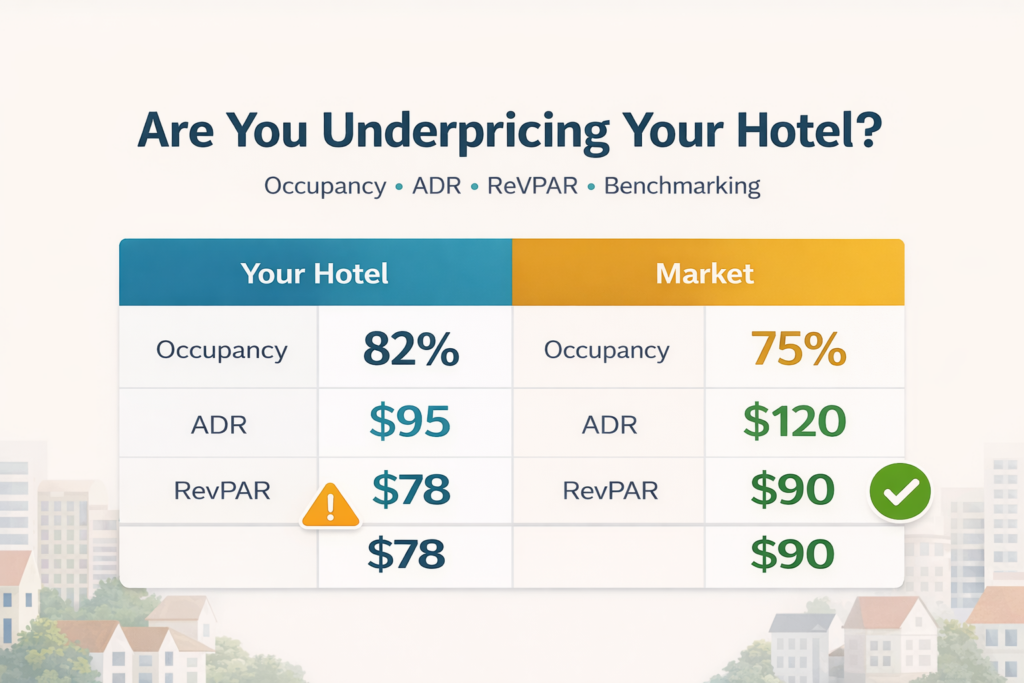
RevPAR is used to understand revenue; it refers to revenue per available room.
RevPAR can be calculated by occupancy rate * ADR.
Occupancy rate refers to what % of rooms are booked. An old way of estimating this is by checking how many rooms have lights on on a Saturday night. This will give you a rough idea whether the hotel is busy or not busy.
ADR is the typical revenue earned per one night of booking for a room. One can simply estimate this by checking an online site with various check-in and check-out dates to see how much a room could earn per day.
You can do a rough estimation, and talk to the owner to get a better idea of it (though it’s likely to be on a more optimistic side).
Here’s where the hotel market data comes into play. There are professional service companies like STR.com and Airbtics, which specialize in tracking key hotel market metrics: market-level occupancy rate, daily rate, and RevPAR.
Companies like STR.com, Lighthouse, and Key Data get data from PMS (Property Management Software). The PMS tracks reservations made for those hotels, and those data companies gather data that way.
Alternative data companies like Airbtics.com track data from platforms like Booking.com and Airbnb. We check the calendars of each hotel, the number of rooms available for each night, and make an estimation on demand and supply over a long period of time.
The advantage of alternative data is that it can capture bookings from almost all hotels, since most hotels are now on websites like Booking.com. When a company tracks data from PMS, it can be biased as they can only obtain data from hotels that use certain software. However, PMS data is cleaner and more reliable in general.
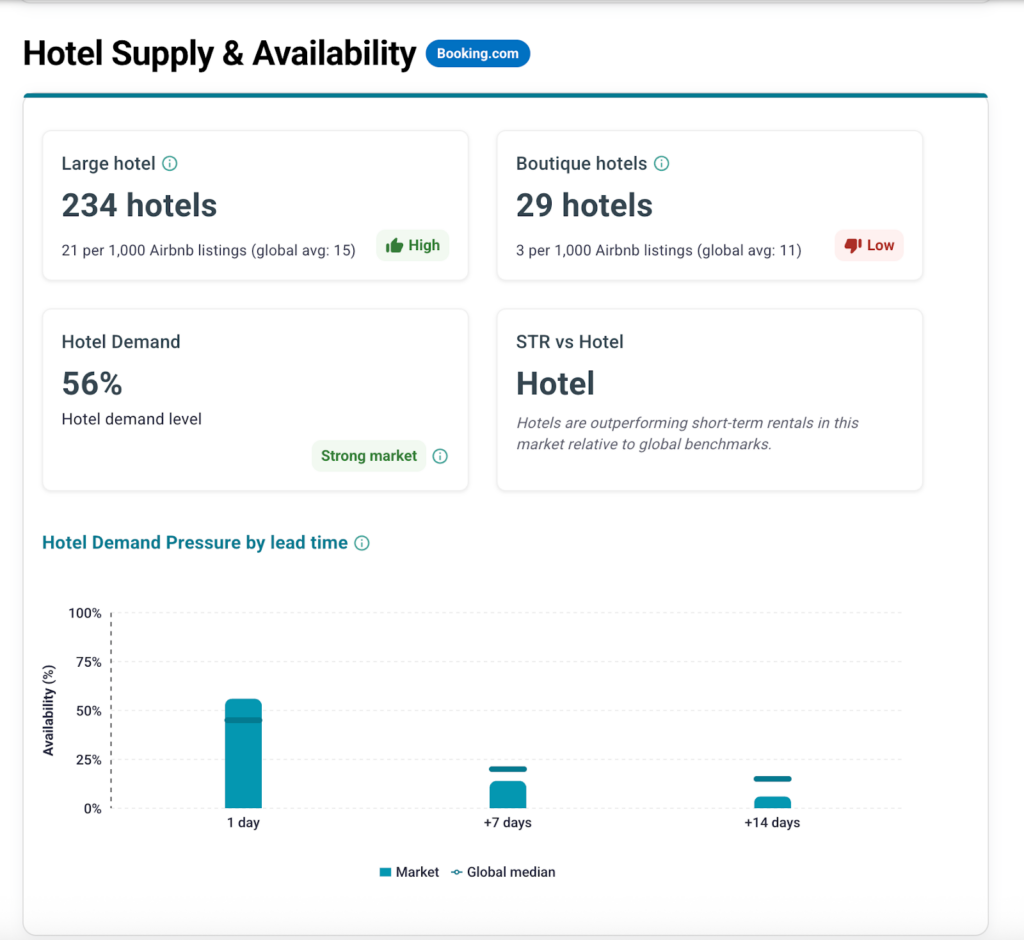
At Airbtics, we track hotel’s market average occupancy rate from Booking.com, and compare this to other competing markets. This helps you to choose the best cities to start your hotel business.
The supply of hotels vs short-term rental is another interesting piece of information, as it’s preferable to you to start your hotel in an area where hotel demands are stronger than short-term rentals. Airbnb type of units can be a threat, especially to boutique hotel owners.
It’s always good to have clear benchmarking occupancy rate and ADR numbers of your market within your segment (budget, luxury, business traveller, etc.).
The purpose of benchmarking is to understand how your performance compares to your competitors.
Here are examples of common weaknesses:
If you see an area where you are underperforming, you can identify the root causes and address this. That alone can help your business generate more revenue.
Things like your weekday vs weekend occupancy rates against the market, mid-term booking occupancy, and occupancy rate by room segment can reveal so much.
Again, for these types of hotel performance metrics, you can get the data and reports from STR.com, Lighthouse, and Airbtics.
You don’t want to leave money on the table. If you are setting rates too low, you want to increase them a little to maximise your RevPAR.
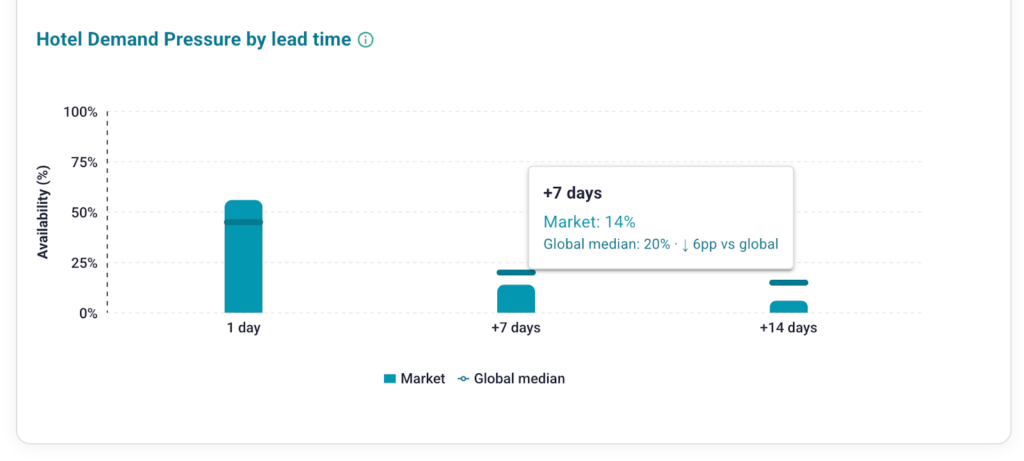
You need to consider things like booking lead time, holidays, and length of stay. If your rooms are all sold out one month in advance, there is room for you to increase rates and still sell out all the rooms.
For peak season, you don’t want to sell out too fast either. Selling out too early often means your prices were too low. On the other hand, during slower periods, adjusting rates or offering promotions can help improve occupancy.
Looking at booking patterns over time can help you find the right balance between occupancy and nightly rates.
Some hotels use revenue management software like IDeaS, Duetto, RateGain, RoomPriceGenie, or PriceLabs to help with this. These tools analyse booking trends and recommend better pricing automatically. Even if you don’t use these tools, understanding your booking patterns alone can already help you make better pricing decisions.

One way is to understand what guests are constantly demanding, such as check-in and check-out times, which amenities are being used, and what feedback you are getting.
For example, you may notice many guests requesting late check-out, or frequently using certain amenities. This tells you what guests value the most.
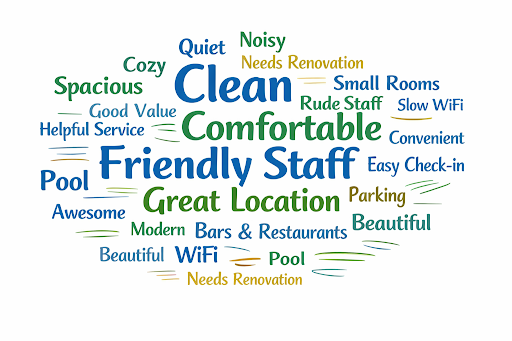
Guest reviews are also very useful. If you see repeated complaints or suggestions, improving those areas can directly improve guest satisfaction.
Over time, this leads to better reviews, more repeat guests, and stronger overall performance.
You can start collecting guest information. Some hotels ask for email when guests connect to WiFi, which you can later use to keep them in the loop about your hotel updates and promotions.
You can also understand the age, guest country of origin, and general profile. These insights can help you run Meta ads or targeted promotions to attract guests with similar profiles.
Instead of marketing to everyone, this allows you to focus on guests who are more likely to book your hotel.
Shares
Get Access to our weekly data-driven airbnb report!